How the Big Banana Car Was Built (One Slice at a Time)
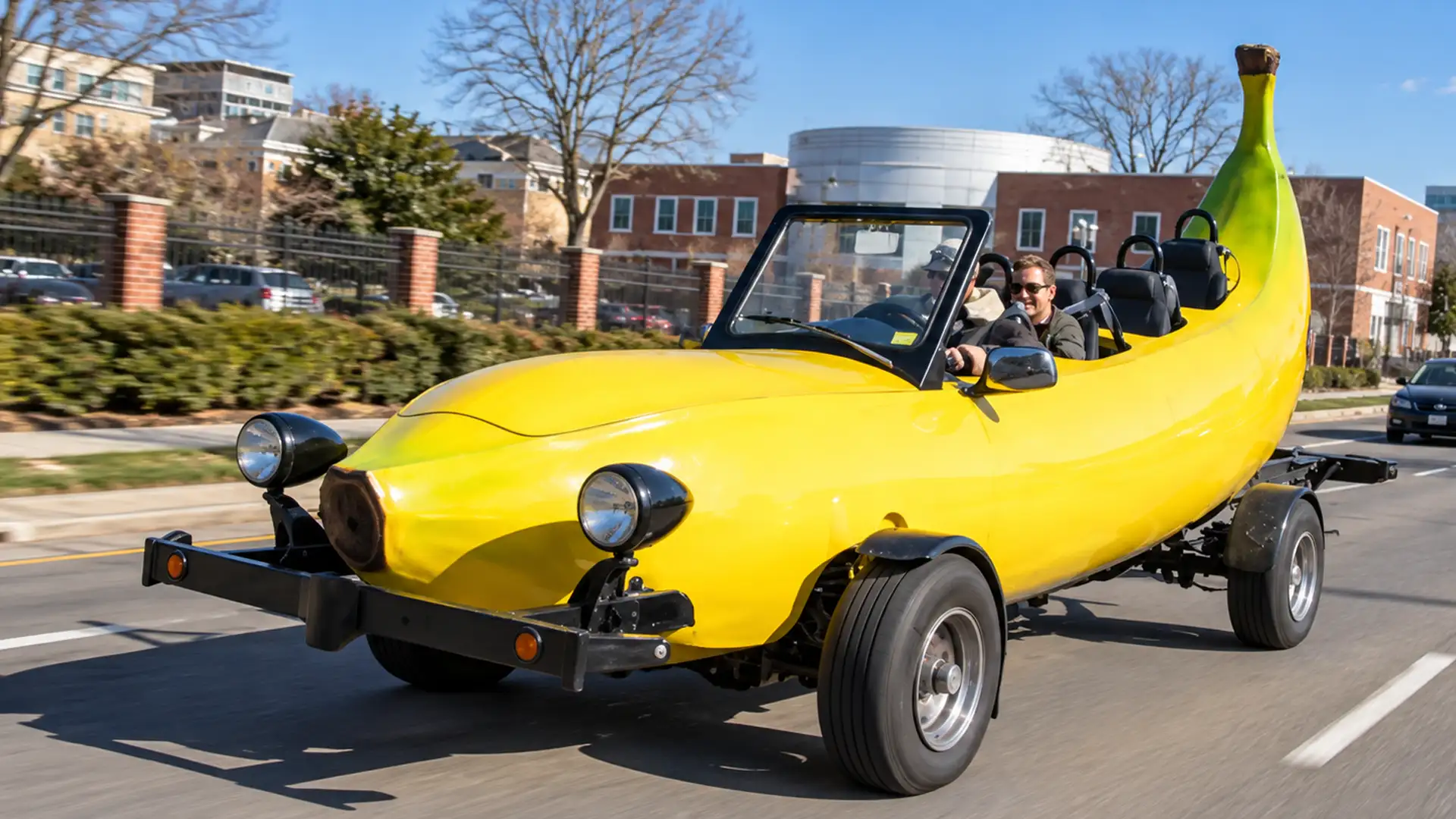
People tend to ask Steve Braithwaite two things about the Big Banana Car. The first is whether it's real. It is, although Steve cheerfully admits he's the one who started the online rumor that it isn't.
The second is how on earth he built it. The short answer: slowly, mostly on Sundays, with a lot of help from people who had no obvious reason to say yes.
The build at a glance
Started: 2008. Finished: about two and a half years later. On the road since: 2011.
Donor vehicle: a 1993 Ford F-150 pickup.
Built in: Bowling Green, Ohio, then Quakertown, Pennsylvania, and finished in Coopersburg, Pennsylvania.
Body: rebar skeleton, chicken wire, spray foam and fiberglass.
Crew: Steve and a group of friends known as the Mutant Brothers, even though one of them is a woman.
Claim to fame: listed in the 2026 Guinness World Records book as the World's Longest Custom Banana (pages 62–63).
Four chairs and a junkyard pickup
Before anyone cut a single piece of metal, Steve lined up four chairs on the floor to work out how much room a four-seat banana would need. On day one, that was the entire engineering department: four chairs, a tape measure and a grin meant to suggest he knew what he was doing.
Then came the junkyards. Steve measured frame widths and wheelbases on every likely candidate, and the winner was a 1993 Ford F-150. It wasn't glamorous, but it had the right frame, a working engine and suspension worth keeping.
The crew stripped off every panel until only the chassis remained, then spent a while grumbling about the rust. Glenn Singer and Leo Moyer of Custom Services Company in Quakertown sandblasted the frame on a brutally hot day. The frame came out looking fantastic. Glenn, sealed inside his protective gear, did not.
The blueprint was an actual banana
There were no CAD files. There was a banana.
Steve picked one that ran fairly straight before curving at the back, the shape he wanted the car to take. He sliced it every inch and traced around each slice. The tracings were scanned into a computer, projected full size onto particle board and cut out with a jigsaw.
So every curve on the Big Banana Car began as a cross-section of that one piece of fruit, scaled up to fit a pickup frame. The fruit itself did not survive the process.
From steel skeleton to fiberglass skin
The wooden profiles went onto the Ford chassis like ribs and served as a guide for welding a banana-shaped skeleton out of rebar. As the steel took shape, the wooden forms came out. Steve's advice from experience: roll your sleeves down when you weld. Spatter burns.
After that, the body went on in layers:
Chicken wire over the whole rebar frame (which, Steve points out, also keeps your chickens from escaping).
Tyvek on the inside of the wire, so the foam wouldn't blow straight through.
Versi-Foam sprayed over the outside.
The foam sculpted into a banana with saws, Surforms and sandpaper.
A full skin of fiberglass. Or "fibreglass," as Steve, who grew up in Oxfordshire, England, prefers to spell it.
Sanding and filling. Then more sanding and filling.
That last step took hours, then days, then more days. Anyone tempted to build something similar should budget their patience around the sanding, not the welding.
A paint job that came looking for him
A local paper ran a story on the build. Airbrush artist Rick Willens read it, decided he wanted to be part of it, and called Steve.
Rick brought in Jim Lacey of J&L Auto Body in Colmar, whose team (Jim, Jim and Jim) laid down the yellow base coat. Jim spent most of the job grinning and shaking his head. Keystone Automotive in Bethlehem, where Steve bought most of the fiberglass and body supplies, had heard about the project so often that they offered the banana-yellow paint for free.
Rick then airbrushed the car to look like a real banana. It took about five hours, with Steve directing, Liz filming and Jim mixing the colors.
Getting a banana past inspection
A car that looks like fruit still has to stop like a car. The team at Yerkes Auto in Quakertown ran all the brake lines, hooked up the master cylinder and booster, and bled the system until the pedal was firm.
The seats came from a Pontiac Fiero, thanks to a stranger's front yard. Steve had been driving past a house with a couple of Fieros parked outside, so he stopped to ask about them. The owner, Gene Toner, turned out to be a serious car nut and was hooked on the project within minutes.
Melody Lakes Tire and Auto donated four new tires. Then John and his crew at Broadway Speedshop in Fountain Hill did the "Specially Constructed Vehicle" inspection and the car's first Pennsylvania safety inspection. That made it official: a road-legal banana.
The people who said yes
None of this happened without the crew. Mark Steele got the project moving fast at his body shop in Bowling Green. Liz O'Neil offered her large workshop in Quakertown and plenty of good ideas. Ron Kutt, a third-generation welder, handled steel, and Hoover Steel even gave him some of his supplies at no charge.
Gene Toner the younger, a mechanic who spots fixes before Steve has noticed the problem, joined the elder Gene on the crew. Mike Hinkle, the local "mechanic's mechanic" other shops call when they're stumped, lent his skills. Steve Myers filmed it all. Kelli and Rob made junkyard runs and did the heavy lifting when the engine was swapped.
Some help came out of nowhere. One day a little black car covered in writing pulled into the driveway. Its owner, Matt Kelly, had driven it across Canada and Russia. He came back the next day with his girlfriend Lindsey and helped get the banana ready for paint.
And Glen Lewis, a gifted mechanic who could take the rough outline of a job and quietly finish it before anyone looked up, is no longer with us. He's part of every mile this car has driven.
Where the banana went next
Since 2011 the Big Banana Car has driven coast to coast and north to south. It has covered most of the lower 48 states, spent six weeks in Canada and a few days in Mexico. The next goal is to drive it around the world. Steve isn't certain that's possible, but he's going to try.
You can see where it's been on the Travels page, watch the full build slideshow on The Build page, or book the Big Banana Car for your own event.
Big Banana Car build FAQ
What is the Big Banana Car built on? A 1993 Ford F-150 pickup, stripped down to the frame, engine and suspension.
How long did it take to build? About two and a half years, starting in 2008, working mostly on Sundays and the occasional weeknight.
What is the body made of? A rebar skeleton covered in chicken wire, Tyvek, sprayed foam and fiberglass, then airbrushed to look like a real banana.
Is the Big Banana Car street legal? Yes. It passed Pennsylvania's Specially Constructed Vehicle inspection and has been on public roads since 2011.
Is it in the Guinness World Records book? Yes. The 2026 edition lists it as the World's Longest Custom Banana on pages 62–63.
Comments
No comments yet. Be the first.