


Are Bananas Radioactive? The Surprising Science Behind the Banana Equivalent Dose
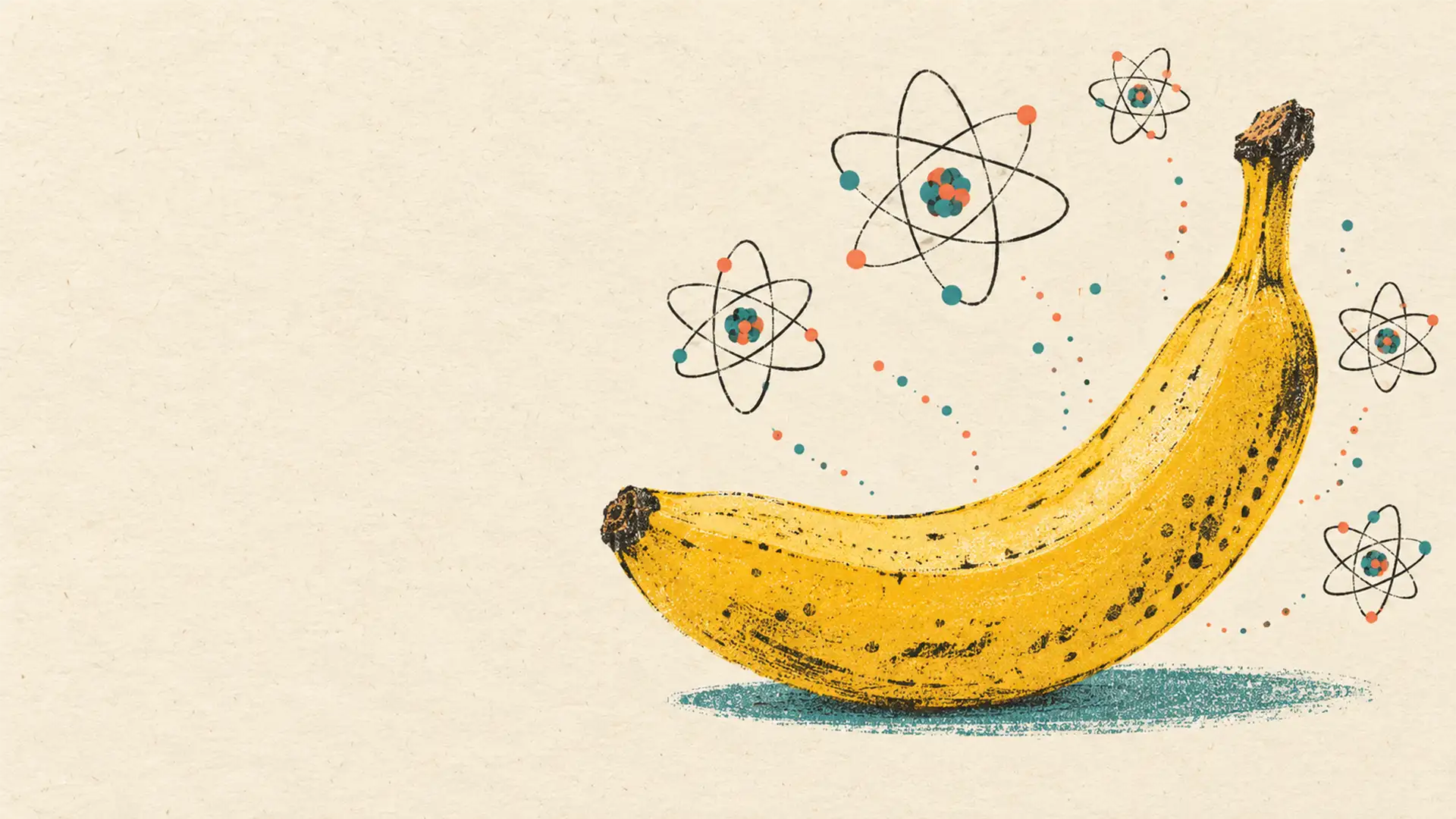
Yes, bananas are slightly radioactive. They contain potassium, and a tiny fraction of all natural potassium is potassium-40, a radioactive isotope. One banana delivers roughly 0.1 microsieverts of radiation, about one-thousandth of a chest X-ray. It's so small that physicists use it as a joking unit, the "banana equivalent dose," to explain tiny exposures.
So, are bananas radioactive enough to worry about? Not even close. But the story of how a humble fruit became physics' favorite measuring stick is a good one. It involves a 19th-century chemist, an isotope older than the Earth, and a 1995 mailing-list post that took on a life of its own. Let's peel it back.
Why Are Bananas Radioactive?
Bananas are radioactive because they're rich in potassium, and about 0.012% of all potassium on Earth is potassium-40, a naturally radioactive isotope. Your banana didn't do anything wrong. It's just chemistry.
Natural potassium comes in three isotopes. Potassium-39 and potassium-41 are stable. Potassium-40 is not. A medium banana contains roughly 420 milligrams of potassium, according to USDA nutrition data. That means it carries a small crowd of potassium-40 atoms that occasionally decay, giving off a beta particle or a gamma ray.
Potassium-40 has a half-life of about 1.25 billion years. The atoms in your fruit bowl were forged in ancient stars before our planet existed, and they've been slowly decaying ever since. Banana plants pull potassium from the soil and can't tell one isotope from another, so a little potassium-40 comes along for the ride.
Who figured out that potassium was radioactive?
English chemist Humphry Davy first isolated potassium in 1807 by running electric current through molten potash. He had no idea it was radioactive. Nobody did, because Henri Becquerel wouldn't discover radioactivity until 1896.
In 1905, J.J. Thomson noticed that potassium gave off faint radiation. Norman Campbell and Alexander Wood confirmed it in 1906. The specific culprit, potassium-40, was identified in the 1930s, with physicist Alfred Nier often credited around 1935.
How Radioactive Is a Banana, Really?
A typical banana contains about 13 to 15 becquerels of potassium-40, meaning roughly 15 atoms decay every second. Eating one gives you an estimated dose of about 0.1 microsieverts (μSv).
Two units are doing the work here:
Becquerel (Bq): one radioactive decay per second, named for Henri Becquerel.
Sievert (Sv): a measure of radiation's biological effect on your body, named for Swedish medical physicist Rolf Sievert. A microsievert is one-millionth of a sievert.
Here's the humbling part. An adult human body contains roughly 4,000 to 5,000 becquerels of potassium-40 at any given moment [VERIFY]. You are far more radioactive than any banana. Your fruit should arguably be more worried about you.
What Is the Banana Equivalent Dose?
The banana equivalent dose (BED) is an informal unit equal to the radiation you get from eating one banana, about 0.1 μSv. Scientists use it to make tiny, abstract doses feel concrete.
The idea is usually credited to Gary Mansfield of Lawrence Livermore National Laboratory. He described it on RadSafe, a mailing list for radiation-safety professionals, in 1995. The problem he was solving was real. Tell people they've been exposed to "radiation" and many will panic. Tell them it's like eating a banana, and they relax.
The unit got a huge boost in 2011. After the Fukushima Daiichi nuclear accident in Japan, cartoonist Randall Munroe published a radiation dose chart on xkcd that included banana-eating alongside flights and X-rays. It spread widely and made "banana dose" a household joke.
Note the "half-jokingly." No scientific agency measures dose in bananas, and you won't find BED in any official unit system. It's a teaching tool, not a measurement standard.
How Many Bananas Would It Take to Hurt You?
It would take roughly 10 million bananas' worth of radiation to cause radiation sickness. That's physically impossible to eat, so you'd run out of stomach, grocery budget, and lifespan long before bananas became dangerous.
Here's how bananas stack up against everyday exposures:
| Exposure | Approximate dose | Banana equivalent |
|---|---|---|
| Eating one banana | 0.1 µSv | 1 |
| Cross-country U.S. flight | ~35 µSv | ~350 |
| Chest X-ray | ~100 µSv | ~1,000 |
| Average American’s annual dose (NCRP) | ~6,200 µSv | ~62,000 |
| Threshold for acute radiation sickness | ~1,000,000 µSv (1 Sv) | ~10,000,000 |
The table is what makes the banana equivalent dose useful. When a news report mentions an exposure of "a few microsieverts," you can picture a small bunch of bananas instead of a mushroom cloud.
Why Do Some Scientists Dislike the Banana Equivalent Dose?
Critics point out that your body doesn't hold on to the extra potassium from a banana. A healthy body keeps its potassium levels tightly balanced, and the kidneys flush out the surplus. So the banana's potassium-40 doesn't build up over time.
That makes the banana a slightly awkward comparison. Some other radioactive substances can linger in the body for much longer. Comparing them to a banana can make them sound more harmless than they are. Some health physicists argue that the true added dose from eating a banana is effectively close to zero.
Most experts still accept the BED as a rough, friendly ballpark. Just treat it like a banana: good for everyday use, not for precision engineering.
Legend or fact? You'll often read that truckloads of bananas set off radiation detectors at ports and border crossings. Reports of "nuisance alarms" from naturally radioactive cargo such as bananas, kitty litter, and ceramic tile are widely repeated. It's plausible and frequently cited, but track down a primary source before treating it as gospel.
Are Other Foods Radioactive Too?
Yes. Virtually all food contains some natural radioactivity. Bananas are the most famous example, not the most radioactive one.
Plenty of potassium-rich foods carry potassium-40 too, including potatoes, beans, spinach, and avocados. Brazil nuts are a standout: they can contain radium, which the Brazil nut tree's extensive root system absorbs from the soil. Every living thing also contains carbon-14, which is how radiocarbon dating works.
So why did the banana win the fame? It's cheap, universally recognized, famously potassium-rich, and a little bit funny. That combination is hard to beat.
And whether your great-grandparents ate the Gros Michel, the banana variety that dominated before Panama disease devastated it in the mid-1900s, or you eat today's Cavendish, the potassium-40 is the same. Radioactivity is one banana tradition that never changed.
Quick facts: Are bananas radioactive?
Bananas are slightly radioactive because they contain potassium-40, a natural radioactive isotope.
About 0.012% of all natural potassium is potassium-40.
Eating one banana gives an estimated dose of about 0.1 microsieverts.
One chest X-ray is roughly equal to 1,000 bananas' worth of radiation.
The human body contains far more potassium-40 than any single banana.
The "banana equivalent dose" is an informal teaching unit, not an official measurement.
Frequently asked questions
Is it safe to eat bananas every day? Yes. The radiation from a banana is trivial, and your body keeps potassium levels steady by excreting the excess. Potassium itself is an essential nutrient for your heart, muscles, and nerves. People with kidney disease may need to limit potassium for medical reasons, but that concerns the mineral, not radiation.
Can a banana set off a Geiger counter? A single banana barely nudges a Geiger counter above normal background radiation. A big box of bananas, or a jar of potassium chloride salt substitute, gives a more noticeable reading. That's why some science teachers use them in classroom demonstrations. Either way, the levels are completely harmless.
Who came up with the banana equivalent dose? The idea is usually credited to Gary Mansfield of Lawrence Livermore National Laboratory, who described it on the RadSafe mailing list in 1995. It circulated among radiation-safety professionals and teachers, then went mainstream in 2011 when xkcd's widely shared radiation dose chart featured banana-eating.
Are organic bananas less radioactive? No. Every banana needs potassium to grow, and potassium-40 makes up roughly 0.012% of natural potassium everywhere on Earth. A banana's radioactivity depends on how much potassium it contains, not on whether it was grown organically or conventionally.
Is the banana equivalent dose an official unit? No. Scientific agencies measure radiation dose in sieverts (or rem in the United States), not bananas. The banana equivalent dose is an informal teaching tool, and even its fans admit it's rough. It's best at one job: showing that "radiation" and "danger" aren't automatically the same thing.
Conclusion: The bottom line
Are bananas radioactive? Technically, yes. Thanks to potassium-40, every banana gives off a whisper of radiation, about 0.1 microsieverts per fruit. That's so tiny that physicists turned it into a joke unit, the banana equivalent dose, to help the rest of us put radiation in perspective. The real takeaway is that radiation is everywhere, including inside you, and the dose makes the difference.
Hungry for more fruit-bowl science? Sign up now so you never miss a peel of banana history.


Comments
No comments yet. Be the first.