Going Bananas: How a Fruit Became American Slang for Crazy
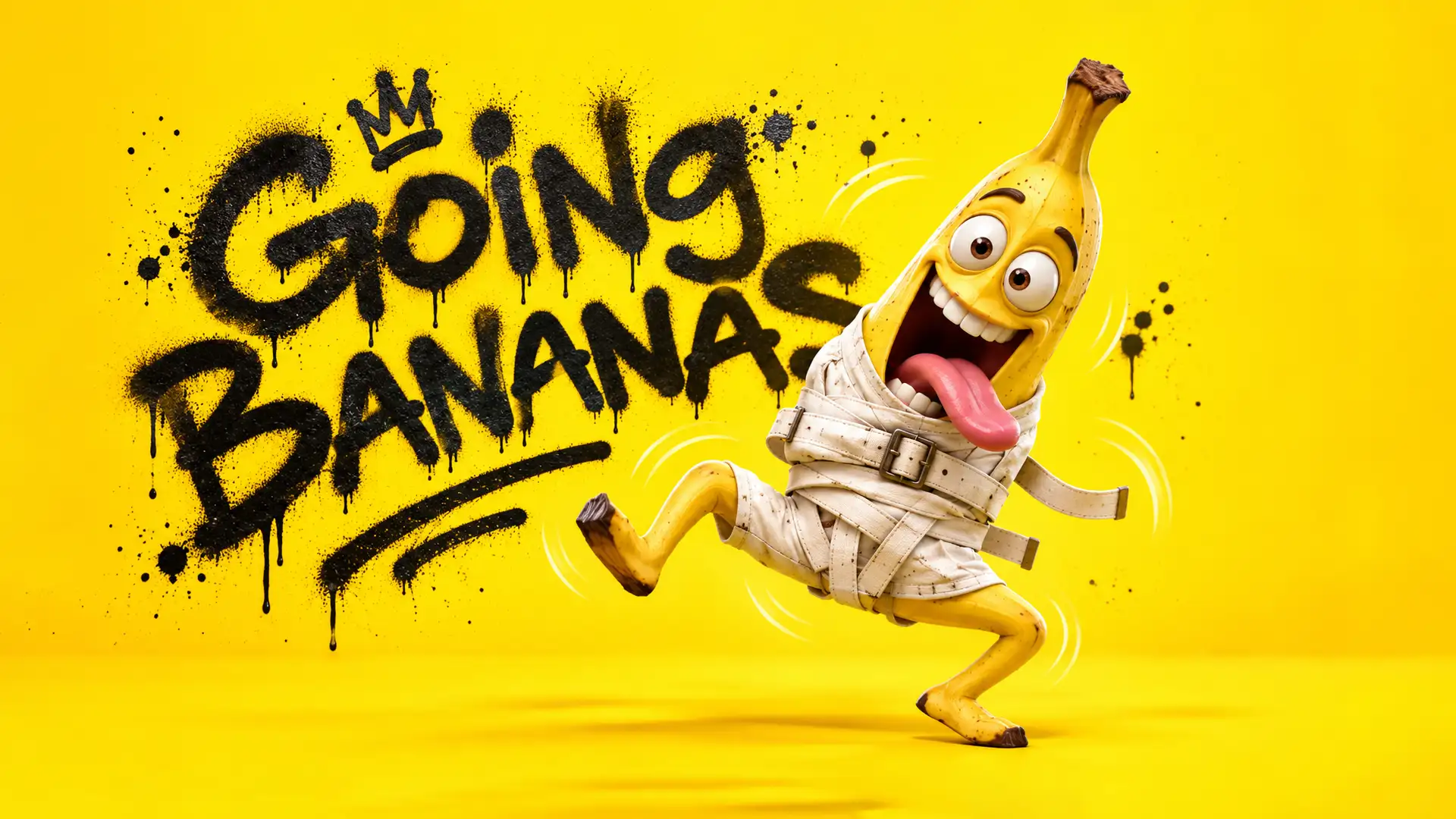
Nobody has ever been driven crazy by a banana. It's the most agreeable thing in the produce aisle: cheap, soft, pre-wrapped, impossible to hate. And yet when a crowd erupts, a toddler melts down, or your inbox hits four hundred unread, the word that comes out is bananas.
The phrase "going bananas" settled into American English in the middle of the 20th century, and it got there by a stranger route than you'd guess. It passed through flapper wisecracks, a 1930s criminal glossary, and, if the most popular theory holds, a few excitable apes before landing in everyday speech.
Here's how a piece of fruit became a synonym for losing it.
Before anyone went bananas
Bananas had a slang life long before they meant crazy. In the 1920s, "banana oil" was flapper-era shorthand for nonsense or flattery you shouldn't believe. If a fellow told you your hat was the cat's pajamas and you didn't buy it, you might fire back with "Banana oil!" Slang dictionaries such as Routledge and Partridge point to this as the likely seed of the crazy meaning, with examples going back to the late 1910s and 1924.
The next sighting is darker. A 1935 glossary of criminal slang, The Underworld Speaks, listed "he's bananas" as meaning a man was sexually deviant. That reflected the prejudices of the time, when homosexuality was widely treated as a mental illness, and it shows the word was already sliding toward "not right in the head."
Then it went quiet. Unlike "nuts," which had meant crazy since the 1840s, "bananas" hadn't yet found its footing in mainstream speech.
When it finally caught on
The modern meaning surfaced in the 1960s. Writers tracking the phrase find "bananas" for crazy coming back into use by the early part of the decade, and dictionaries date its arrival in general American English to the late '60s: Etymonline pegs it at 1968, Dictionary.com at 1965 to 1970.
The timing makes sense. Postwar American slang was having a moment, fed by teenagers, comedians, and a booming TV industry. The language already had "nuts," "bonkers," and "go ape," which was circulating in the 1950s. A fruit word fit right in, and it sounded funnier than the alternatives.
Bananas were also everywhere in pop culture. Top Banana, a 1951 Broadway musical starring Phil Silvers, borrowed the old vaudeville term for the lead comic. The Banana Splits hit Saturday morning TV in 1968, and Woody Allen titled his 1971 comedy about a hapless revolutionary simply Bananas. None of these invented the phrase, but they kept the word in America's ear as a shorthand for silliness and chaos.
By the 1970s, you could go bananas, drive someone bananas, or simply be bananas, and nobody needed it explained.
So why bananas?
Nobody has a signed confession, but three explanations come up again and again.
The ape theory. This is the favorite. "Go ape" already meant to lose control, and in the popular imagination apes and monkeys go wild for bananas. Swap the animal for its snack and you get "go bananas." It's tidy, and the timing lines up well.
The banana oil theory. Here the crazy meaning grows out of the 1920s sense of nonsense. Talking banana oil meant talking rubbish; being bananas meant your head was full of it. The slang dictionaries lean this way, though there's a long gap between the flappers and the 1960s.
The shape theory. A banana is bent, and "bent" has long meant crooked or off-kilter. This one gets mentioned a lot and proven never.
The honest answer is probably a mix. Slang rarely has a single parent. "Banana" had been hanging around the edges of weird for decades, and "go ape" gave it a ready-made frame. Add the fact that the word itself is fun to say, with its bouncing repeated syllables, and it was always going to stick.
How we use it now
"Bananas" has quietly picked up a second job. It still means crazy or furious ("my landlord went bananas about the dog"), but it also means wildly excited ("the crowd went bananas when she hit the high note"). Lately it's become an all-purpose reaction word for anything absurd: "Eight dollars for a coffee? That's bananas."
That range is part of its staying power. "Crazy" can sting, and plenty of people have started avoiding it for that reason. "Bananas" carries the same energy with a wink, which makes it easy to say about a price tag, a plot twist, or your own week.
So the next time something sends you over the edge, remember you're borrowing from flappers, Depression-era crooks, and a few imaginary apes. Not bad for a fruit that just wanted to sit in a bowl on the counter.
Comments
No comments yet. Be the first.