

Is a Banana Tree a Tree? The Surprising Truth About the World's Biggest Herb
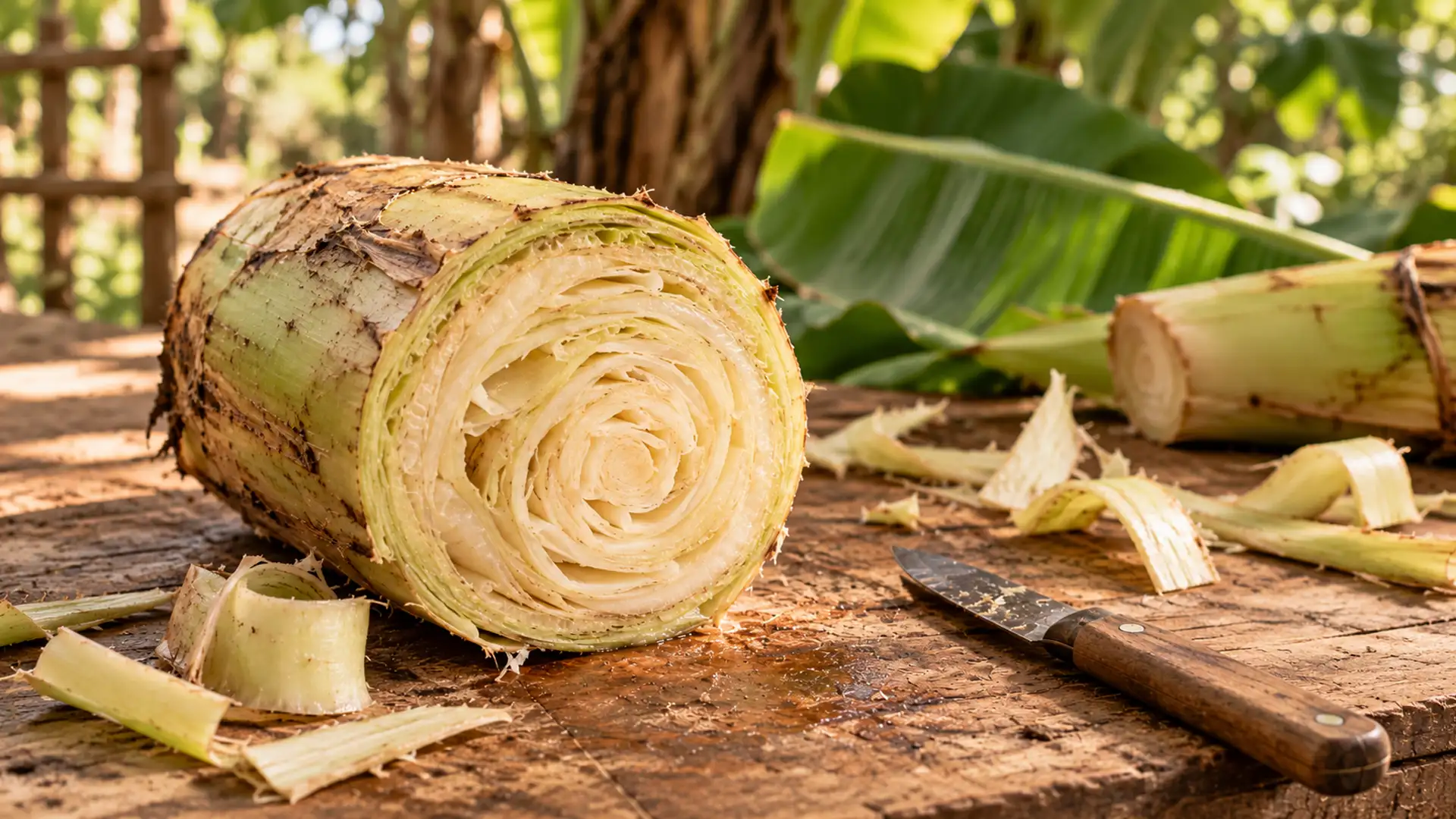
Is a banana tree a tree? No. Botanically, the banana plant (genus Musa) is a giant herb, often called the world's largest herbaceous flowering plant. Its "trunk" is a pseudostem: a column of tightly rolled leaf sheaths with no wood inside. The true stem is an underground corm that sends up new shoots.
So the swaying "tree" on every tropical postcard has more in common with a colossal leek than with an oak. As a banana historian, I find this deeply satisfying. One of the world's most familiar fruits comes from one of its most misunderstood plants. Let's peel it back, one sheath at a time.
Is a Banana Tree a Tree or a Herb?
It's a herb. In botany, a herb (or herbaceous plant) is simply a plant with no persistent woody stem above ground. It has nothing to do with the basil on your pizza.
Trees earn their title by making wood. A layer of tissue called the vascular cambium adds new wood every year, which is why an oak has growth rings. Bananas never do this. They're monocots, the same big branch of flowering plants as grasses, lilies, and orchids, and they don't build a woody trunk.
Bananas belong to the family Musaceae, in the order Zingiberales. That order also includes ginger, turmeric, and bird-of-paradise. Your banana is closer kin to the spice rack than to the apple orchard.
The heavyweight champion is Musa ingens, a wild banana from the highlands of New Guinea reported to reach about 15 meters or more. Most cultivated bananas stand far shorter, roughly 3–6 meters. One caveat: "world's largest herb" is a popular superlative, not an official botanical record. It's well-earned bragging rights, not a certificate.
What Is a Banana Pseudostem?
A pseudostem ("false stem") is the banana's trunk look-alike. It's built from the overlapping bases of its leaves, called leaf sheaths, rolled tightly around one another. There's no bark, no wood, and no tree rings.
Each new leaf forms at the plant's center near ground level and pushes up through the middle of the older sheaths. It emerges at the top as a tight green "cigar," then unfurls into a huge paddle-shaped blade. Older sheaths get pushed outward, layer after layer.
Slice a pseudostem crosswise and you won't find wood grain. You'll see concentric rings, just like a cut leek.
How does a column of leaves hold up a heavy bunch of fruit? The sheaths are packed tightly, and their water-filled tissue stiffens under what botanists call turgor pressure. Think of a rolled-up magazine standing on end while a single page flops over. Pseudostems still have limits, which is why growers often prop up heavily laden plants with poles.
Where Is the Banana Plant's Real Stem?
Mostly underground. The true stem is a thick, starchy corm (often loosely called a rhizome) at the base of the plant. It's where the roots, new shoots, and eventually the flower stalk begin.
For most of the plant's life, the corm's growing tip stays low and churns out leaf after leaf. Once the plant is mature, that tip switches jobs. It sends a true stem straight up through the hollow center of the pseudostem, like an elevator rising through a building, until it bursts out the top.
At the end of that stalk hangs a large, usually purplish bud called the banana "heart" or "bell." Rows of female flowers develop into "hands," and each banana is a "finger." The fruit starts out pointing down, then curves upward as it grows, bending away from gravity. That's where the famous banana curve comes from.
Does a Banana Tree Die After Fruiting?
Yes, but only the pseudostem. Each pseudostem flowers and fruits just once, then dies back, while the underground corm lives on.
Even before the fruit ripens, the corm sends up side shoots called suckers, or "pups." A parent stem plus its suckers forms a clump growers call a mat or stool. After harvest, farmers cut down the spent pseudostem and let a chosen sucker, the "follower," take over. They often prefer narrow-leaved "sword suckers" to broad-leaved "water suckers" because sword suckers tend to be more vigorous.
This cycle lets a banana patch keep producing for years without anyone planting a seed. It's also why supermarket bananas are essentially clones. The dominant export variety, Cavendish, is seedless and sterile, so it's propagated from suckers or lab-grown tissue culture.
That variety has an aristocratic backstory. It's named for William Cavendish, 6th Duke of Devonshire, whose head gardener, Joseph Paxton, grew it in the Chatsworth greenhouses in England in the 1830s. Cloning has a cost, though, because identical plants share identical weaknesses. The earlier export favorite, Gros Michel, was devastated by Fusarium wilt (Panama disease) in the mid-20th century. A newer strain, Tropical Race 4, now threatens Cavendish.
Why Do We Call It a Banana Tree?
Because it looks like one. People named plants by appearance long before botanists sorted them by growth. A plant taller than a house, with a trunk-like column and a leafy crown, reads as "tree" to almost anyone.
We've had a long time to get attached to that name. Archaeological evidence from Kuk Swamp in the highlands of Papua New Guinea suggests people were cultivating bananas there roughly 7,000 years ago. The Kuk Early Agricultural Site is now a UNESCO World Heritage Site. Bananas later spread through South Asia and Africa, and Portuguese and Spanish voyagers carried them to the Atlantic islands and the Americas in the 1500s.
The names themselves are a little murky. The English word "banana" likely arrived via Portuguese or Spanish from a West African language. Wolof is often cited, but the exact source is debated. Carl Linnaeus used the genus name Musa in his 1753 Species Plantarum. It may honor Antonius Musa, physician to the Roman emperor Augustus, or derive from the Arabic mauz, meaning banana. Historians still disagree.
So "banana tree" isn't a blunder. It's folk language, and English is full of it. Peanuts aren't nuts, and strawberries aren't true berries, yet botanists do count the banana as one. Botany has a sense of humor.
What Can You Do With a Banana Pseudostem?
Plenty. Around the world, people eat it, weave it, and twist it into rope.
Philippines: Abacá (Musa textilis), a banana relative, yields a tough leaf-sheath fiber sold as "Manila hemp." It was prized for ship ropes and is still used in specialty papers and tea bags.
Okinawa, Japan: Weavers make a traditional cloth called bashōfu from Japanese fiber banana (Musa basjoo).
South India: The tender inner core of the pseudostem, vazhaithandu in Tamil, goes into stir-fries, curries, and juices.
Ethiopia: Enset (Ensete ventricosum), the "false banana," is a staple. Its pseudostem and corm are scraped and fermented into a bread-like food called kocho, and the crop supports an estimated 20 million people.
Quick Facts: The Banana "Tree"
The banana plant is a herb, not a tree, because it produces no woody stem.
Its "trunk" is a pseudostem made of tightly rolled leaf sheaths.
The true stem is an underground corm that produces roots, leaves, and suckers.
Each pseudostem fruits only once, then dies and is replaced by a sucker.
Bananas belong to the order Zingiberales, alongside ginger and turmeric.
Botanically, a banana counts as a berry.
Frequently Asked Questions
Do bananas grow on trees? Not technically. Bananas grow on giant herbs in the genus Musa. The plant looks like a tree, but its "trunk" is a pseudostem made of rolled leaf sheaths, with no wood inside. Calling it a banana tree is fine in everyday speech. Botanists just prefer "banana plant."
Is a banana a berry? Yes. Botanists classify the banana as a berry, a fleshy fruit that develops from a single flower's ovary. Wild bananas are packed with hard seeds. The bananas we buy come from sterile varieties like Cavendish, so their seeds are reduced to the tiny dark specks you see in the center.
Is the banana plant a type of grass? No, though they're distant cousins. Bananas and grasses are both monocots, the large group of flowering plants with a single seed leaf and usually parallel leaf veins. But bananas belong to the order Zingiberales, with ginger and turmeric, while grasses belong to the order Poales.
How tall do banana plants get? Most cultivated banana plants stand roughly 3 to 6 meters (10 to 20 feet) tall, and dwarf varieties stay much shorter. The giant of the family, Musa ingens from New Guinea, is reported to reach about 15 meters or more. That's why bananas are often called the world's largest herb.
How long does a banana plant live? Each pseudostem lives only until it fruits once, often within about a year in warm conditions. The underground corm keeps sending up new suckers, though, so a single clump, called a mat, can keep producing fruit for many years. It's less a single plant than a family business.
The Bottom Line
So, is a banana tree a tree? Botanically, not even close. It's a giant herb with a pseudostem of rolled leaf sheaths and a real stem hiding underground. Each stalk fruits once, then hands the job to its pups. Next time you peel a banana, you'll know you're eating the berry of the world's most convincing tree impersonator.
Hungry for more? Set up a FREE account so you never miss a slice of banana history.

Comments
No comments yet. Be the first.