Raiders of the Lost Bunch, Part 1: The Only Banana You've Ever Eaten
It was a Tuesday, and I was standing in the produce aisle holding a banana as if it had personally lied to me.
Nothing was wrong with it. That was the problem. It was yellow, gently curved, about seven inches long, with a blush of green near the stem and a little sticker announcing it had traveled from Ecuador. Behind it sat a pyramid of several hundred more bananas exactly like it. Across town, another store was stacked with the same banana. So was nearly every grocery store in the country, and most of the ones on the planet.
I had eaten bananas my entire life without asking them a single question. They were the fruit equivalent of tap water: always there, always the same, cheap enough to forget. Then I stumbled on a throwaway line claiming there are more than a thousand kinds of banana in the world, and I couldn't shake it. A thousand. I had tried one.
So I made a decision that my family has described, not entirely kindly, as going totally bananas. I was going to find the tastiest banana in the world. Not the most nutritious, not the most photogenic. The tastiest. I would chase it through history, specialty markets, farm stands, and mail-order growers, and I would taste every serious contender I could get my hands on.
This series is the record of that hunt. But every expedition needs a base camp, and mine was the banana in my hand. Before I could go looking for a better banana, I had to understand the one I already had.
A banana with a pedigree

The banana on your counter right now is almost certainly a Cavendish. It accounts for the overwhelming majority of bananas sold internationally, and just under half of all bananas grown worldwide. It is named after William Cavendish, the 6th Duke of Devonshire, which is not a sentence you expect to read about a lunchbox snack.
In the 1830s, the duke's head gardener at Chatsworth House in Derbyshire, a man named Joseph Paxton, acquired a banana plant believed to have come by way of Mauritius, with roots further back in southern China. In the English climate, getting it to fruit was a feat. Paxton managed it in a heated glasshouse and named the variety after his employer. He would later design the Crystal Palace for the Great Exhibition of 1851, so the man clearly knew his way around glass and warmth.
Plants descended from the Chatsworth stock were later carried to the Pacific, including Samoa, reportedly by missionaries, and the variety spread from there. For roughly a century the Cavendish was just one banana among many: short, sturdy, productive, and nobody's favorite. Then a disease wiped out the banana everyone actually preferred, and the Cavendish, which happened to resist it, inherited the world. Hold that thought. It's the subject of the next post.
Every banana is the same banana
Here is the fact that broke my brain. The Cavendish has no seeds. Those faint black specks running down the center are the remnants of seeds that never developed. Wild bananas, by contrast, are packed with hard, stony seeds that make eating one feel like chewing through a mouthful of gravel to reach a thin layer of fruit.
Cultivated dessert bananas like the Cavendish are triploid, meaning they carry three sets of chromosomes instead of the usual two. That odd number scrambles the plant's ability to make viable seeds, which is lovely for snacking and a disaster for reproduction. So farmers don't plant seeds. They cut offshoots, called suckers, from the base of a mature plant and grow new plants from those. Each one is a genetic copy of its parent.
Follow that logic back and the implication is staggering. The banana from Ecuador and the banana from the Philippines are, genetically speaking, the same individual. When you eat a Cavendish, you are eating a piece of a plant lineage older than the duke who named it, copied and recopied across the tropics.
While we're breaking things: the banana "tree" isn't a tree. It's a giant herb, and its trunk is a pseudostem made of tightly rolled leaf bases. Botanically, the banana itself is a berry. I'm told this is a great thing to bring up at parties. I'm told this by no one.
Cloning is why the Cavendish is so consistent, and consistency is why it conquered the supermarket. A grocery chain needs a banana that grows fast, yields heavily, and survives a long voyage in a refrigerated ship. The Cavendish does all of that. It's harvested hard and green, shipped cold, then ripened in warehouses with ethylene gas, the same hormone bananas release on their own to trigger ripening. The result arrives on schedule, in the exact shade of yellow shoppers expect.
But "consistent" and "ships well" aren't flavor notes. Which raised the obvious question.
So how does it actually taste?
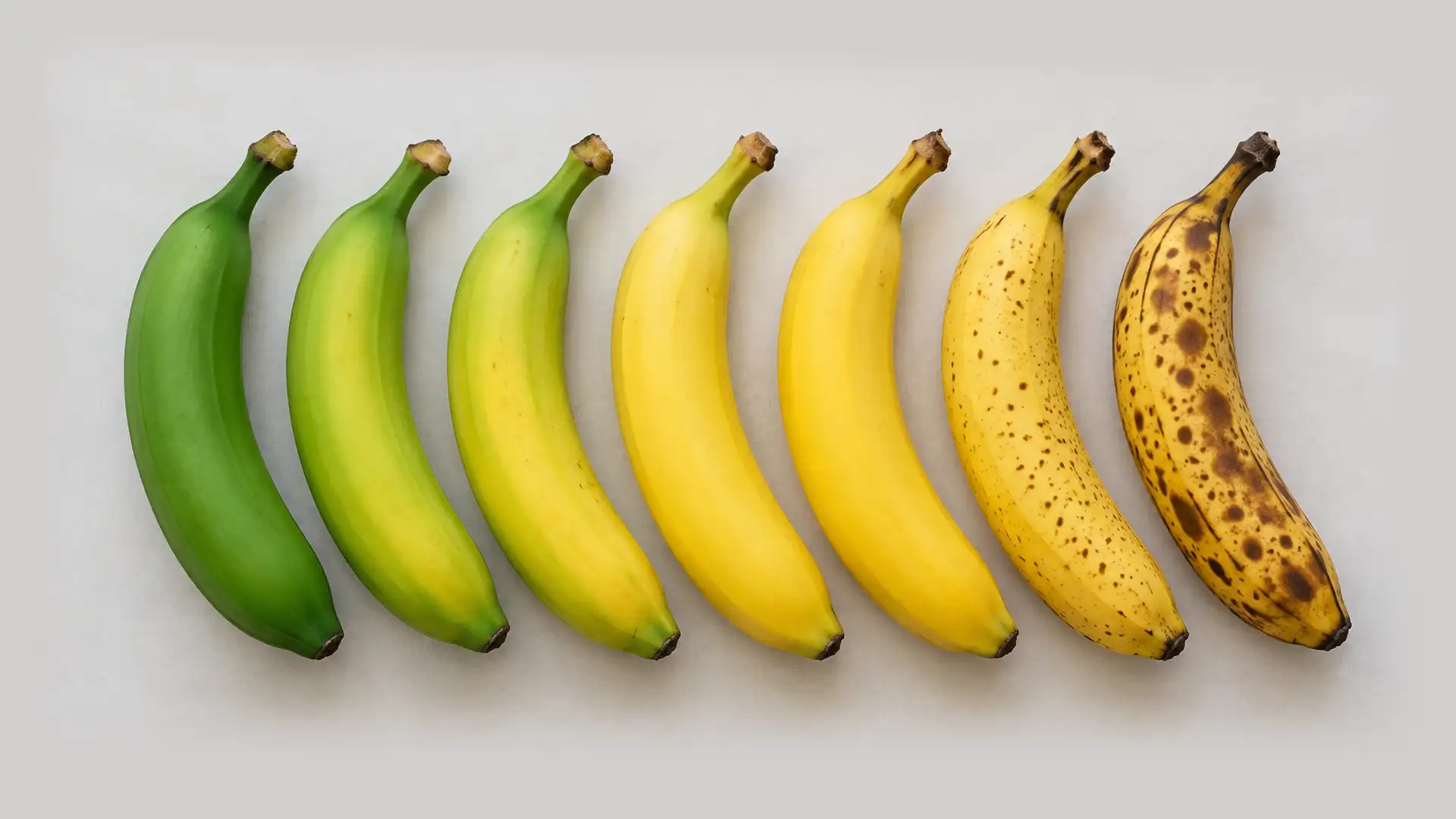
To give the Cavendish a fair hearing, I bought a bunch and ate them at four stages over about a week. If this banana was going to be the benchmark for the whole series, I wanted to know it at its best and its worst.
Green-tipped. Firm enough to squeak against my teeth, with a faintly chalky texture. The sweetness was timid, the aroma grassy, and a slight astringency dried out my tongue on the finish. This is a banana still under construction: much of its carbohydrate is still starch, not yet sugar.
Fully yellow. The banana of every lunchbox. Smooth and creamy but a little dense, sweet without being rich, with almost no acidity. The aroma was clean and unmistakably "banana," a note that comes largely from an ester called isoamyl acetate. The finish was short. Pleasant, gone, forgotten.
Freckled. Once brown sugar spots spread across the peel, the Cavendish finally woke up. The flesh turned softer, almost custardy at the center, and noticeably sweeter, with hints of honey and a faint vanilla edge. The aroma bloomed so strongly I could smell it across the kitchen. This was the Cavendish at its peak, and it was genuinely good.
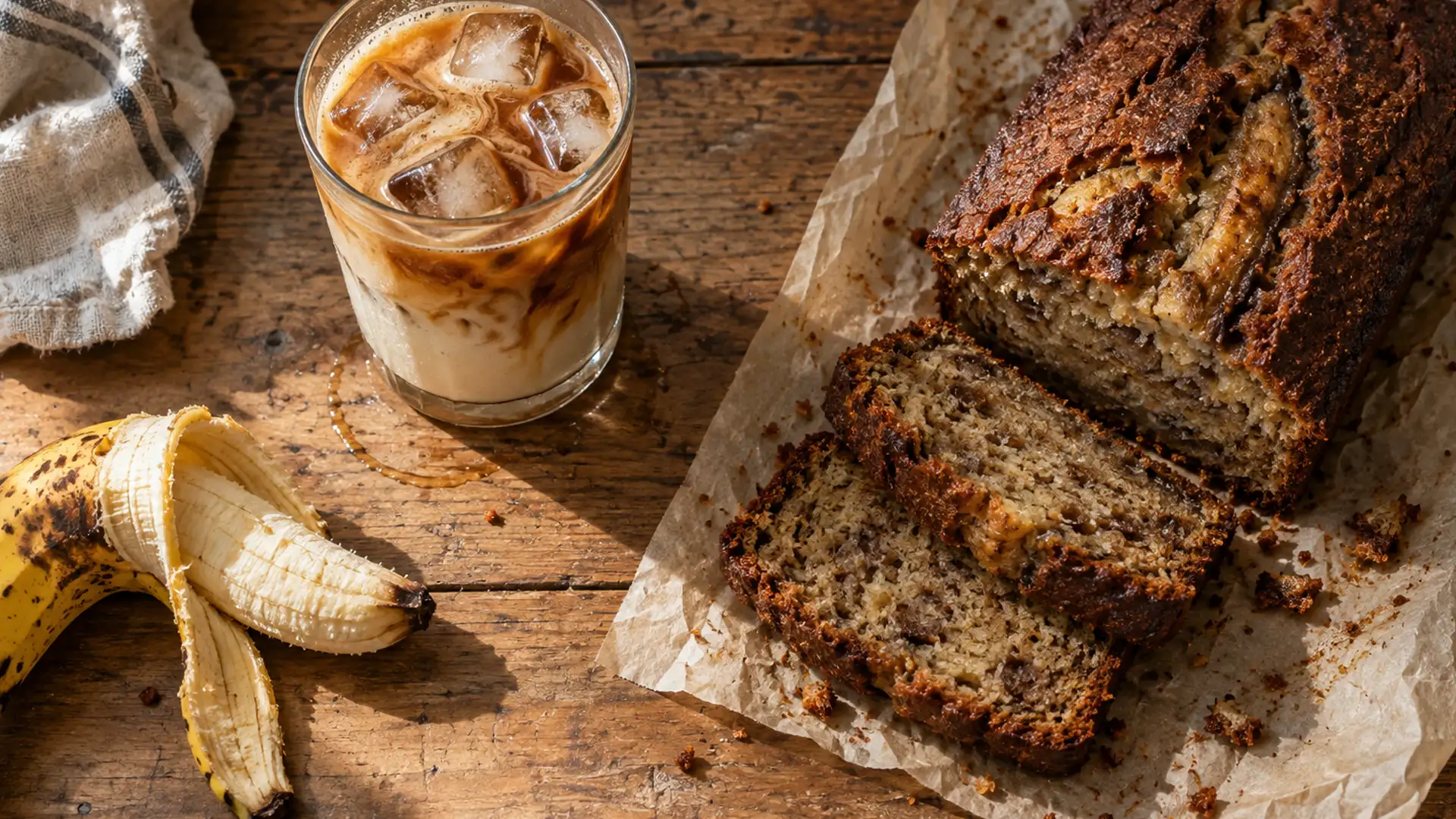
Spotted brown and soft. Past the line for eating out of hand. The sweetness went syrupy, the texture slumped, and a faint fermented note crept in. This is banana bread territory, and no shame in that.
My verdict: a well-ripened Cavendish is a perfectly nice thing to eat. But even at its best, it plays a single note. Sweet, creamy, mild, done. There's little acidity to make the flavor pop, no surprising aroma, nothing that lingers. It tastes like the idea of a banana, and for most of us that's exactly what it is. When we say "banana flavor," we really mean "Cavendish flavor," because it's the only reference point we've ever had.
The banana was chosen for us
None of this makes the Cavendish a villain. It's a remarkable achievement that a tropical fruit is cheap, available year-round, and sitting in nearly every store on Earth. That's not nothing.
But the Cavendish wasn't chosen because it tasted best. It was chosen because it survived, shipped, and scaled. Flavor was, at most, a tiebreaker. The banana most of us know was selected by shipping logistics and plant disease, not by anyone's taste buds.
Which means the tastiest banana in the world could be sitting in a market in Kerala, a backyard in Hawaii, or a grower's catalog, completely unknown to most of the people who eat a banana every morning. And somewhere in the past is a banana that an entire generation swore was better, before it vanished from store shelves almost overnight.
That's where the hunt goes next.
| Category | Score (out of 10) |
|---|---|
| Sweetness | 6 |
| Texture | 6 |
| Complexity | 3 |
| Availability | 10 |
| Overall | 5 |
Best eaten freckled, when brown sugar spots cover the peel but the flesh is still firm.
Next time on Raiders of the Lost Bunch: Our grandparents ate a different banana, and many of them insist it was better. In Part 2, I go looking for the Gros Michel, the ghost banana wiped from supermarkets by a soil fungus. I also put a famous rumor to the test: that the artificial banana flavor in candy actually tastes like a banana most of us have never tasted.
Comments
No comments yet. Be the first.