


Where Did Bananas Originate? Inside the 7,000-Year Journey of One of the World's Oldest Crops
Bananas originated in New Guinea and Southeast Asia. The earliest archaeological evidence of banana farming comes from Kuk Swamp in the highlands of Papua New Guinea. There, people were deliberately cultivating bananas at least 6,950 to 6,440 years ago, making the banana one of the oldest domesticated crops on Earth.
That's the short answer. The long answer involves a swamp, a lot of microscopic plant fossils, and a fruit so full of rock-hard seeds that you'd have spat out more than you swallowed. So peel back a few layers with me, and let's find out where bananas originated and how they conquered the world.
Where did bananas originate?
The banana's story starts in the humid forests stretching from New Guinea through Southeast Asia, where wild banana species still grow today. Archaeologists place the first known banana farming in the New Guinea highlands, at a site called Kuk Swamp.
Why there? The wild ancestor of many modern bananas, a subspecies called Musa acuminata ssp. banksii, grows naturally in New Guinea. Early farmers didn't have to import anything exotic. They simply started paying closer attention to the plants already growing around them.
New Guinea also holds a bigger title. It's one of only a handful of places on Earth where people invented farming independently, alongside regions like the Fertile Crescent, China, Mesoamerica, and the Andes. Bananas were part of that homegrown revolution, together with taro and yams.
What did wild bananas look like?
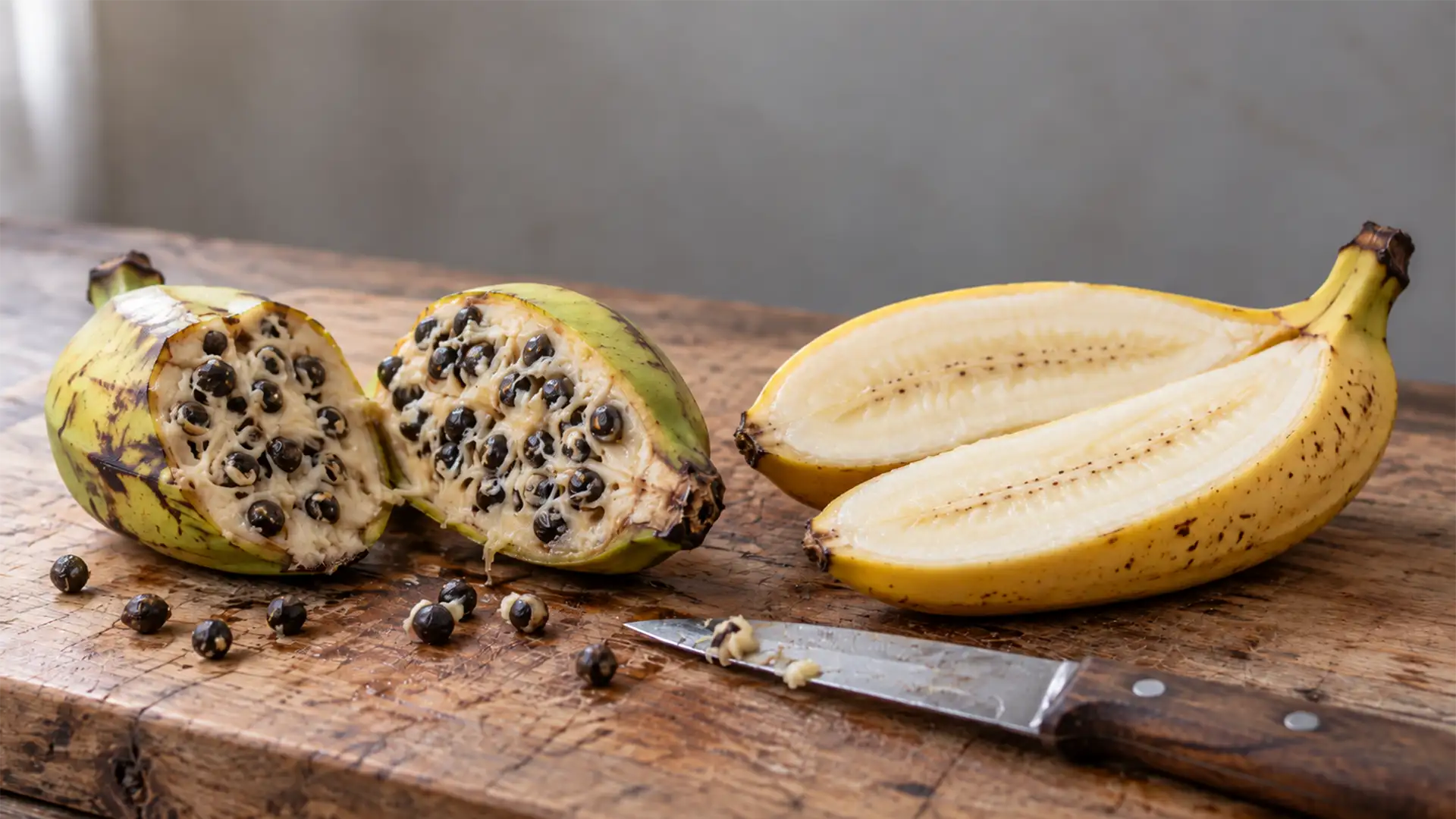
Wild bananas looked a lot like the ones in your kitchen, but eating one was a very different experience. Their flesh was packed with hard, peppercorn-sized seeds and held relatively little pulp.
Over thousands of years, people favored plants that produced fruit with fewer seeds and more flesh. Some bananas developed the ability to form fruit without pollination, a trait botanists call parthenocarpy. Those tiny black specks in a modern banana are what's left of the seeds its ancestors carried.
There was another reason bananas suited early farmers. You don't need seeds to grow them at all. New plants sprout from the base of the parent as "suckers," so farmers could simply dig one up and replant it, cloning their favorite plants over and over.
What is Kuk Swamp, and why does it matter?
Kuk Swamp is a 116-hectare wetland in the Wahgi Valley of Papua New Guinea's Western Highlands, sitting about 1,500 meters above sea level. UNESCO added it to the World Heritage List in 2008 as the Kuk Early Agricultural Site.
The site was first studied by Australian archaeologist Jack Golson, starting in the 1970s [VERIFY start date]. Later, a team led by archaeologist Tim Denham of the Australian National University ran detailed tests on the swamp's layers. Their findings, published in the journal Science in 2003, put Kuk on the map of world history.
The researchers found a remarkably long story of farming, told in three main phases:
About 10,000 years ago: people were already exploiting and cultivating plants along the wetland's edge.
By 6,950 to 6,440 years ago: farmers were building planting mounds, and bananas were being intensively cultivated.
By 4,350 to 3,980 years ago: farmers were digging drainage ditches with wooden tools to turn swamp into garden.
UNESCO describes this as a technological leap from gathering wild plants to true agriculture. The same land is still farmed today.
How do scientists know bananas were farmed 7,000 years ago?
Scientists know because of phytoliths, microscopic bits of silica that form inside plant cells and survive long after the plant rots away. Banana phytoliths have a distinctive shape, so researchers can identify them in ancient soil.
Here's the clever part. Bananas produce relatively few phytoliths compared with grasses. So when researchers found a high concentration of banana phytoliths in what had become a cleared, grassy landscape, it pointed to deliberate planting, not bananas growing wild by chance.
This kind of detective work matters because the tropics are tough on evidence. Seeds, peels, and fruit decay quickly in wet soil, so archaeologists rely on microfossils, pollen, and features like mounds and ditches to reconstruct the past.
How did bananas spread from New Guinea to the rest of the world?
Bananas spread westward from New Guinea through the islands of Southeast Asia, carried and replanted by people. Along the way, the New Guinea bananas crossed with other wild banana species and subspecies.
Those crosses produced sturdier bananas with three sets of chromosomes, known as triploids. Triploids tend to be seedless and vigorous, which made them perfect for farmers. They spread across Southeast Asia, into India, and eventually to Africa, possibly more than 2,000 years ago, though the exact timing is debated [VERIFY].
From there, the banana's journey reads like a world tour. Arab traders carried bananas around the Middle East and Mediterranean. Portuguese sailors brought them to the Canary Islands in the 1400s, and Spanish friar Tomás de Berlanga is credited with bringing them to the Americas in 1516.
Is New Guinea the only birthplace of the banana?
Probably not. Kuk Swamp holds the oldest known archaeological evidence, but most researchers think bananas were domesticated more than once, in different places across New Guinea and Southeast Asia.
Think of Kuk as the earliest chapter we've found, not necessarily the only one. Tropical sites are hard to excavate, and many older clues may have simply rotted away. New finds could still rewrite parts of the banana's story.
Quick facts box
Place this box right after the intro or in a sidebar.
Birthplace: Bananas originated in New Guinea and Southeast Asia.
Oldest evidence: Kuk Swamp, Papua New Guinea, where bananas were intensively cultivated by at least 6,950 to 6,440 years ago.
World Heritage status: UNESCO inscribed the Kuk Early Agricultural Site on the World Heritage List in 2008.
Key ancestor: Musa acuminata ssp. banksii, a wild banana native to New Guinea.
How we know: Microscopic silica fossils called phytoliths reveal where bananas were deliberately planted.
Seedless secret: The black specks inside a modern banana are the remnants of seeds its wild ancestors carried.
FAQ
How long have humans been growing bananas? Humans have grown bananas for at least 7,000 years. Evidence from Kuk Swamp in Papua New Guinea shows intensive banana cultivation between 6,950 and 6,440 years ago. People at the same site were already managing wild plants around 10,000 years ago, so the relationship may be even older.
Did bananas originally have seeds? Yes. Wild bananas are full of hard seeds, often the size of peppercorns, with only a little edible pulp around them. Early farmers favored plants with fewer seeds and more flesh. Over time, this produced the nearly seedless bananas we eat today, which are grown from cuttings rather than seeds.
Are bananas native to Africa or the Americas? No. Bananas are native to New Guinea and Southeast Asia, and people carried them everywhere else. They reached Africa long ago, possibly more than 2,000 years back, though scholars still debate the date. Spanish colonists brought them to the Americas in the early 1500s.
What other crops were grown at Kuk Swamp? Alongside bananas, early farmers at Kuk Swamp grew taro and yams. All three can be propagated from pieces of the parent plant rather than seeds. UNESCO highlights this vegetative propagation as central to the site's importance in the independent invention of agriculture in New Guinea.
Can you visit the Kuk Early Agricultural Site? Yes, the site lies in the Wahgi Valley, roughly 12 to 13 kilometers northeast of Mount Hagen in Papua New Guinea's Western Highlands. Most of the archaeological evidence is buried, so visitors see working farmland rather than ruins. Check current travel advisories and arrange a local guide before going.
Conclusion
The seedy little fruit that went global
So, where did bananas originate? In the forests of New Guinea and Southeast Asia, where early farmers at Kuk Swamp were planting them at least 7,000 years ago. They took a seedy wild fruit, replanted the best suckers generation after generation, and started a journey that would carry the banana to nearly every tropical corner of the planet.
The next time you peel one, remember that you're holding the result of thousands of years of human patience, and a clone of a plant someone chose very, very long ago.
Hungry for more banana history? Subscribe so you don't miss our next deep dive, and share this post with the trivia lover in your life.
Sources to cite
UNESCO World Heritage Centre: Kuk Early Agricultural Site — site size, elevation, 2008 inscription, and the 7,000 to 6,400-year farming transition.
Denham et al., "Origins of Agriculture at Kuk Swamp in the Highlands of New Guinea," Science (2003) — the core study dating banana cultivation to 6,950 to 6,440 years ago.
PubMed record of the same Science paper — a free-to-read abstract, handy for readers without a journal subscription.
Denham, "Early Agriculture and Plant Domestication in New Guinea and Island Southeast Asia," Current Anthropology (2011) — how bananas spread westward and became triploid cultivars.
UNESCO World Heritage Committee Decision 32 COM 8B.26 — the official 2008 inscription and statement of the site's significance.


Comments
No comments yet. Be the first.